
The application of Type-C interface in deep-sea devices is becoming an important breakthrough in the field of underwater technology. With the rapid development of ocean exploration and deep-sea exploration equipment, the reliability issues of traditional connectors in high-pressure, high salt, and high humidity environments are becoming increasingly prominent. In response to this challenge, the waterproof Type-C interface specifically designed for deep-sea equipment has achieved excellent performance without failure after 1000 insertions and removals in a 20MPa pressure chamber through innovative sealing design and material technology, providing a stable and durable connection solution for underwater equipment.
The deep-sea waterproof performance of Type-C interface is primarily attributed to the multi-layer composite sealing structure. Through the integrated design of silicone sealing rings, nano coatings, and metal shells, the interface can still isolate seawater infiltration under extreme pressure. In the 20MPa pressure chamber simulation test, the sealing layer of the waterproof Type-C interface dedicated to deep-sea equipment can withstand external pressure equivalent to a depth of 2000 meters, while maintaining the integrity of signal transmission. This design not only solves the problem of aging of traditional rubber seals, but also extends the service life of the interface in salt spray environments through the anti-corrosion treatment of the metal shell.
The mechanical durability of Type-C interface is another key indicator for deep-sea equipment applications. In 1000 cycles of insertion and extraction testing, the metal contacts of the interface are coated with gold and have an elastic self-cleaning structure to ensure low resistance connection even after repeated insertion and extraction. The test data shows that even after thousands of insertions and removals, the change rate of contact resistance is less than 5%, and the signal attenuation is controlled within 3dB. This breakthrough in performance enables the specialized waterproof Type-C interface for deep-sea equipment to handle long-term deployment and frequent maintenance of marine research tasks, such as applications in underwater robots, underwater observation stations, and other scenarios.
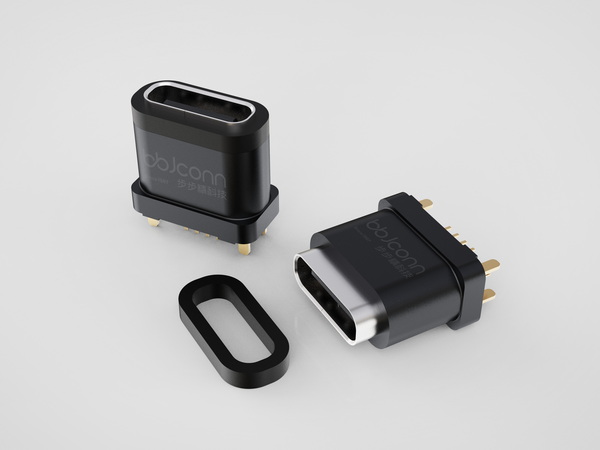
The high voltage tolerance of Type-C interface cannot be achieved without precise structural simulation and material testing. The R&D team optimized the stress distribution of the interface through finite element analysis to avoid sealing failure caused by shell deformation under 20MPa pressure. At the same time, the shell material is a composite structure of titanium alloy and PEEK (polyetheretherketone), which balances lightweight and compressive strength. In the actual testing of the pressure chamber, no cracks or deformations occurred at the interface under extreme pressure, verifying the reliability of its structural design. This dual verification mode of "simulation+actual testing" provides technical support for the engineering application of waterproof Type-C interfaces specifically designed for deep-sea equipment. The electrical performance of Type-C interface has also been tested in deep-sea environments. By incorporating ferrite magnetic rings and double-layer shielded cables, the interface can effectively suppress electromagnetic interference (EMI) even in high voltage environments. Tests have shown that under a pressure of 20MPa, the transmission rate of the interface can stably support the 10Gbps standard of USB 3.2 Gen2, with an error rate of less than 1 × 10? 12. This performance enables it to meet the bandwidth requirements of scenarios such as underwater high-definition cameras and sonar data transmission, laying the foundation for the intelligent upgrade of deep-sea exploration equipment.
The deep-sea adaptability of Type-C interface is driving the innovation of industry standards. The International Marine Engineering Association (IMCA) has included this type of interface in the "Technical Guidelines for Underwater Equipment Connectors", and its testing standards have been adopted by multiple research institutions. In commercial applications, Norwegian deep-sea robot companies have adopted waterproof Type-C interfaces in bulk to replace traditional wet plug connectors, reducing operation and maintenance costs by 40%; The Chinese "Jiaolong" scientific research team has also verified its reliability in experiments. In the future, with the development of emerging fields such as deep-sea oil and gas development and underwater data centers, the high-pressure waterproof technology of Type-C interface is expected to become a universal connection standard for underwater equipment.
The technological evolution of Type-C interface will continue to focus on performance breakthroughs in extreme environments. For example, improving the oxidation resistance of contacts through graphene coating, or using intelligent sealing materials to achieve pressure adaptive dynamic sealing. These innovations will enable the specialized waterproof Type-C interface for deep-sea equipment to remain stable in deeper waters (such as the Mariana Trench) and more complex working conditions, providing stronger technical support for human exploration of ocean mysteries.